As part of our music theory series, we will be sharing multiple short articles on different aspects of chord theory. We started the series with several beginner music theory topics and are now adding some intermediate and advanced topics. If you’re new to music theory, don’t worry — more beginner topics are coming soon, too.
For this chord theory discussion, let’s talk about the difference between an add9 and a 2 chord. For example, Cadd9 versus C2. You may have wondered, “Are they really different? It’s the same note being added.”
Yes, they are different, and it comes down to the scale degree: how the degrees are counted and which pitch outside of the base triad will be included in the final chord.
Typically, a Cadd9 chord is found in the key of G. It occurs elsewhere, but this is most common. It is built on the standard C Major triad (C, E, G).
Here’s where the pitches fall on guitar and on piano:
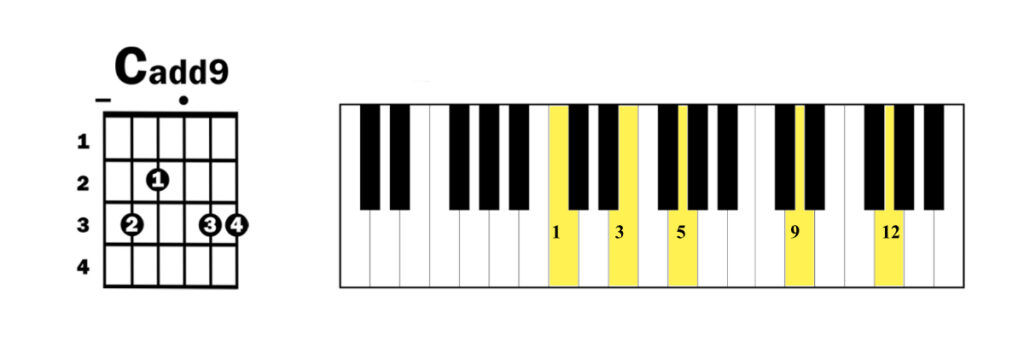
The notes used in the chord are C, E, G, and D with an extra G in the high octave. In the C Major chord, C is the root, also referred to as the 1 of the chord. Counting up from the root, the notes played are 1, 3, 5, 9, 12. Because the G is doubled with the 12, we ignore its presence for the sake of simplicity. This is also true if we choose not to play the high G on guitar and leave the string open resulting in a high E.
A C2 chord is different. The D still gets played, but it is played adjacent to the root note of the chord. That results in the notes C, D, G, C, E and the numbers 1, 2, 5, 8, 10.
Here’s what a C2 looks like on guitar and piano:
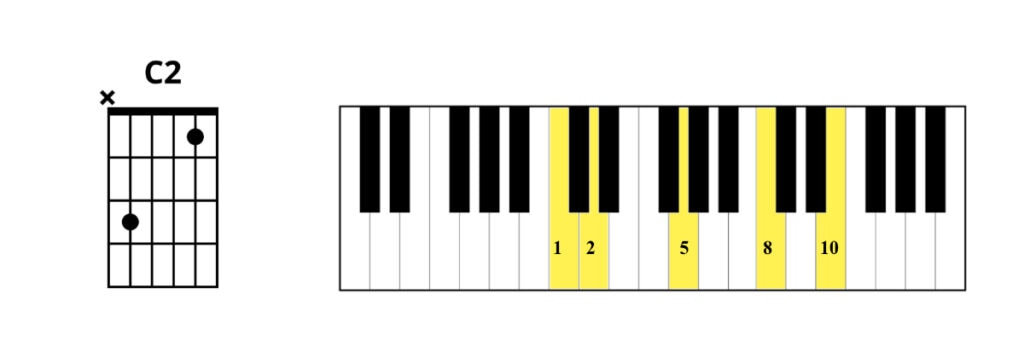
Here we also have the doubling of pitches and disregard their upper octave numbers in naming the chord. It should be noted, however, that the E only occurs in the upper octave (the 10) and should be present to define the chord as being a major chord.
Given the structure of the pitches and the different octaves in which they occur, the sonority (sound quality) of these two chords is notably different. Becoming familiar with chord theory and recognizing the subtle differences between two such chords can help support good decisions when playing music.
Written by Ray Mullins, a CLEF supporter who has served in music ministry and music education for two decades. He is a music teacher in Tennessee and volunteers as a music minister in various parishes in the Memphis area.
Copyright © 2026 Catholic Liturgical Ensemble Formation.
Looking for more resources? Search our full online library of CLEF Life resources, or sign up for CLEF Life email updates to receive the latest resource in your inbox once a week.