If you’ve ever considered adding organ to an ensemble at your parish, you may feel a bit intimidated and unsure where to start. The good news is using the organ doesn’t require finding a trained organist or making drastic changes to your ensemble. With a basic understanding of how the instrument works and some simple approachable ways to incorporate it, you can add depth to your sound as you support the sung prayer in your community.
Imagine this scenario: You arrive at church for your weekly ensemble rehearsal to find your pastor looking around the music area.
“Wouldn’t it be nice if we could use the organ again?” he says.
You think carefully how to respond. No one at the parish plays the organ, and its main purpose in the last few years has been a countertop for extra music, the bag of cough drops, and the three-hole punch.
“Father, no one knows how to play it,” you remark.
“What about our keyboard player? The keys look just the same,” he says with a perplexed look on his face.
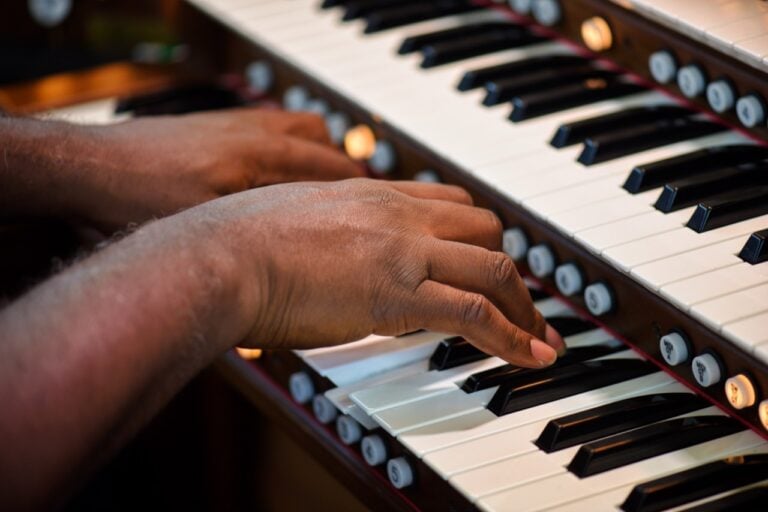
Now, most musicians know that a keyboard or piano differ quite a bit from the organ, but in what ways? First, the technique is completely different. Since there is no sustain pedal on an organ, all legato playing must be done by choice of fingering. In addition, there are stops to pull for different sounds. An organist needs to know what stops to pull when, how many, what the various numbers mean, and which of the two or three keyboards to play. The organ is also not touch sensitive, meaning that the volume stays the same whether you press the keys gently or bang on them. Finally, there is an entire keyboard to play with the feet!
Many keyboardists think the organ looks intimidating, but once you understand the basics of how it works, adding organ to an ensemble can add extra depth to your music.
Common questions about the organ
Why is there more than one keyboard?
On an organ, the keyboards are called manuals. Each corresponds to a certain group of sounds that are accessed by tabs or drawknobs. Most commonly, if there are two manuals, the top is called the Swell, and the bottom is called the Great. If there are three, the top is called the Swell, the middle is called the Great, and the bottom is called the Choir. The different manuals enable the organist to utilize different sounds at the same time, such as the sound of strings accompanying an oboe, for example.
What are the numbers on the stops along with the names?
The numbers tell us the octave that the note will sound. If you see the number 8, it sounds at pitch. If you see the number 4, it sounds an octave higher, just as the number 16 sounds an octave lower. The numbers correspond to the size of the pipe with a pipe organ, but even digital models will emulate those sounds with those numbers.
I’ve never played pitches with my feet… where do I start?
While pedals can add a lot of depth to the sound, you CAN play an organ using just the manuals. If playing the pedals is something you want to try, most people play in either organ shoes or socks. Regular shoes that have rubber soles will make it difficult to slide from note to note. Just as in legato fingering without a sustain pedal, legato pedaling between pitches also needs to be considered. The use of toes versus heels is also something that is helpful, and alternating between them can help with stepwise motion.
Adding organ to an ensemble
Think of the organ as a mini orchestra, which is one of the best reasons for adding organ to an ensemble. After deciding what sound you want and which stop can give you that sound, try using it in place of a solo instrument. No oboe or clarinet player in your ensemble? Use that stop on the organ, and just play the solo line. The organ will also have flute sounds, trumpet sounds, string sounds, etc. While these are not meant to be exact duplicates of the real instrument, they can serve as nice substitutes when needed.
If you are blessed with two keyboardists in your ensemble, the organ and the piano can be used at the same time. One example that I have used in the past is with “Litany of the Saints” by John Becker. The written accompaniment is primarily whole notes. Unlike a piano, if your fingers are holding down the keys on an organ, the sound will continue. Since there is no sound decay, using the organ with some string and/or flute sounds creates a lovely and supportive choral structure to anchor the song. Then, the piano or guitars could arpeggiate those same chords to add depth to the music.
What if you have everything covered in the treble ranges for your ensemble, but don’t have a bass player? If you recall, choosing a stop with the number 16 will sound an octave lower. Many organs will have a 16 on at least one sound for the manuals and almost all will have a 16 on several sounds in the pedal. This gives an ensemble member the flexibility to play a very simple pedal part with their feet, or just use the manual stop to play with their left hand to create a bass part.
Of course, if you want to truly learn the techniques of organ playing, I encourage you to find an organist at a nearby church who can give you some lessons. If you are near a college or university that offers organ lessons, that would be another place to inquire. This is an extremely basic outline of some simple ways to add organ to an ensemble. If the organ at your church is collecting dust in the corner, perhaps these ideas will inspire you to clean it up and start using this fascinating and versatile instrument as part of your ensemble.
Let’s revisit the scenario from the beginning with a new trajectory for the conversation.
“Wouldn’t it be nice if we could use the organ again?” he says.
You think carefully how to respond. No one at the parish plays the organ, and its main purpose in the last few years has been a countertop for extra music, the bag of cough drops, and the three-hole punch.
“Father, no one is trained to play it,” you remark, “but perhaps we could try some simple ways of adding organ to an ensemble.”
“I think our keyboard player could do that! The keys look just the same,” he says with a smile on his face.
Katie Barton is the Director of Sacred Music at St. Thomas Parish in Ft. Thomas, Kentucky where she conducts the Adult Choir, Liturgical Ensemble, Resurrection Choir, and Schola. She has previously served as the Director of Music at Holy Spirit Parish in Newport, Kentucky; St. Timothy Parish in Union, Kentucky; and St. Mary Parish – Hyde Park in Cincinnati, Ohio, for a total of 30 years in music ministry.
Copyright © 2026 Catholic Liturgical Ensemble Formation
Looking for more resources? Search our full online library of CLEF Life resources, or sign up for CLEF Life email updates to receive the latest resource in your inbox once a week.