Major, minor, and diminished triad chords form the basis of chord theory and are the most commonly used chords, especially when first learning your way around an instrument. Other chord types add and/or subtract notes to add more texture and flavor to the chord. One of the most popular of these textural chords is the 7th chord.
So, what is a 7th chord? At its most basic, 7th chords are a traditional triad (major or minor) with an additional note a third above the top pitch. Depending on the chord’s place in the key, the third above the top pitch is either a minor or major third, which means the fourth note in the chord is an interval of either a minor or major seventh from the root of the chord. Hence the name of 7th chords.
Let’s look at some examples.
Say we are in the key of C major and want to make a 7th of the C chord. As the one chord in the key, our C chord is major and made up of a triad of C E G. From G, we go up a third while staying in the C major scale, which is B. Our new 7th chord is made up of C E G B and is commonly referred to as Cmaj7. This is because in the key of C major, B is an interval of a major seventh from the root note.
Here’s what a Cmaj7 chord looks like on the keyboard, the staff, and a guitar chord chart.
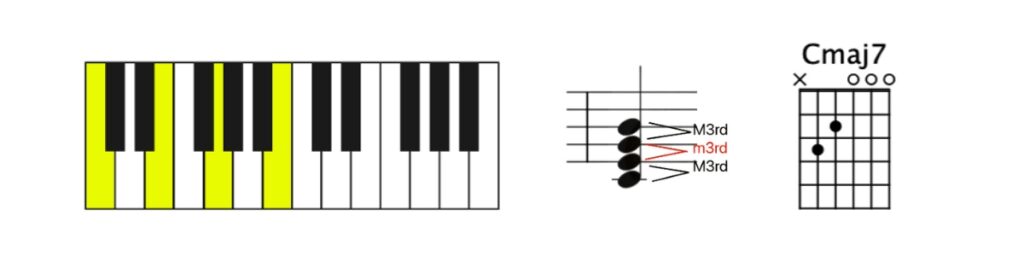
With our knowledge of the key (C major) and the scale, we can interpret the intervals involved in the structure of this chord: major 3rd, minor 3rd, major 3rd. A major 3rd and minor third stacked on a root note creates the major chord triad. Adding another major 3rd creates the major 7th chord.
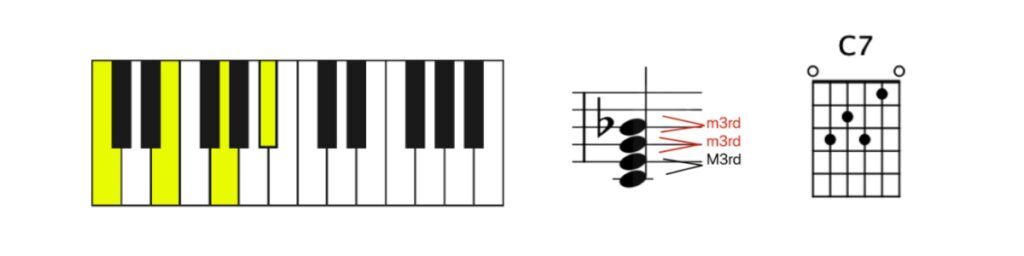
But what if we were using a C major chord while in the key of F major? In F major, the C triad is still C E G, but the third above G in the scale is Bb rather than B. The Bb is a minor seventh from the chord root of C. So, if we called the chord with a major seventh above a Cmaj7, this one would be called a Cmin7, right? Not quite. To avoid confusing this chord with a C minor (triad C Eb G), it’s called a C dominant 7th. Or far more commonly, just C7. When you hear someone mention a 7 chord, they usually mean the dominant. If they mean the major 7, it’s usually called out.
Here’s what the C7 chord looks like on the keyboard, the staff, and a guitar chord chart. Notice the difference on the staff and the keyboard for using the Bb rather than the B note as the fourth tone in the chord.
Up next, we’ll use 7th chords as a springboard to get into 9th chords!
Written by Ray Mullins, a CLEF supporter who has served in music ministry and music education for two decades. He is a music teacher in Tennessee and volunteers as a music minister in various parishes in the Memphis area.
Copyright © 2026 Catholic Liturgical Ensemble Formation.
Looking for more resources? Search our full online library of CLEF Life resources, or sign up for CLEF Life email updates to receive the latest resource in your inbox once a week.