Time signatures, which appear at the beginning of a piece of music, are the key to understanding the beat and meter of the piece. First, we know that most music in modern notation is divided into measures. A measure (or a “bar”) is a small unit of music that contains the same number of beats. The time signature tells you how many beats belong in each measure.
The formula for time signatures
Time signatures have two numbers, one on top and one on bottom. The top number indicates how many beats per measure; the bottom number indicates what type of note gets the beat.
4/4 is an extremely common time signature and is sometimes noted as a “c” for Common Time.)
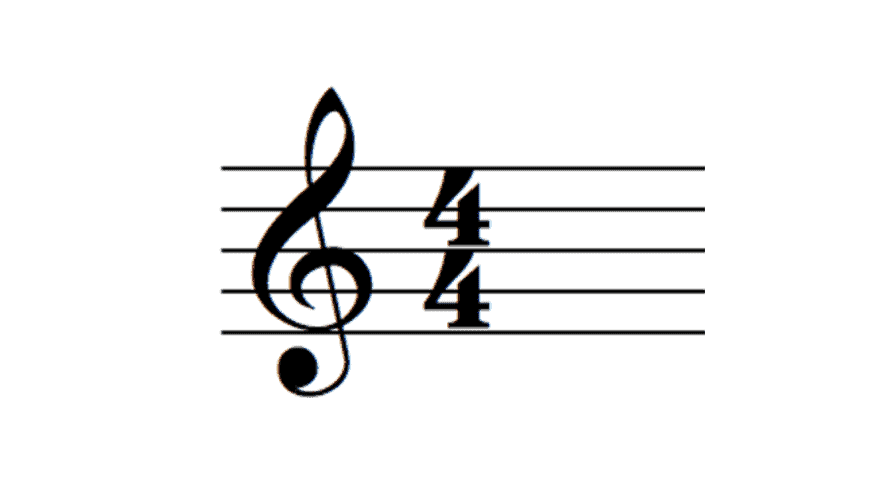
The 4 on top tells you that each measure has 4 beats, which are counted as 1–2–3–4. 1–2–3–4. The 4 on bottom tells you that each beat is a quarter note.
Other frequent time signatures include 3/4, 2/4, and 6/8.
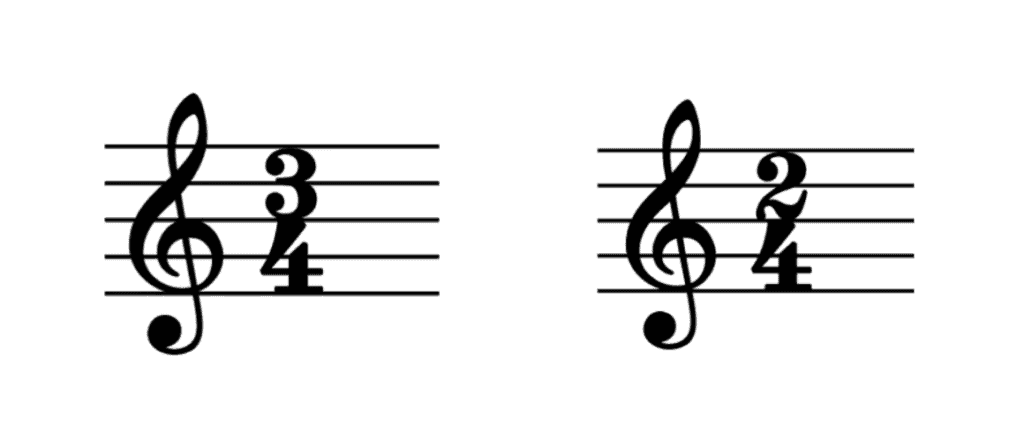
In 3/4, there are 3 quarter notes per measure, which are counted as 1–2–3, 1–2–3.
In 2/4, there are 2 quarter notes per measure, which are counted as 1–2, 1–2.
Knowing the formula allows you to read any time signature.
- 2/2 = two half notes per measure
- 6/4 = six quarter notes per measure
- 3/8 = three eighth notes per measure
Strong beats and weak beats
Let’s break down the time signature 6/8.
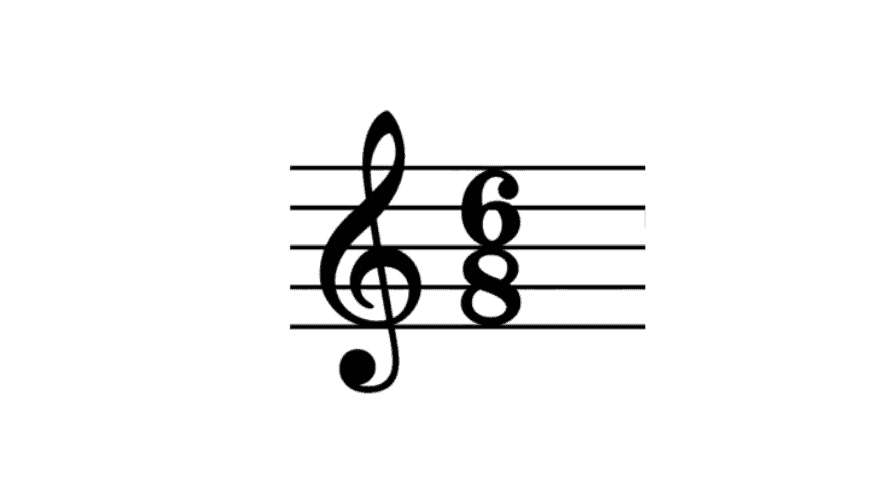
In 6/8 time, there are 6 eighth notes per measure. The 8 on the bottom refers to eighth notes. (Think 1/8.)
Time signatures help us determine the strong and weak beats of each measure. Think of word stress when reading poetry and the different meters that help you speak in a proper flow. No one wants robotic music or poetry!
The down beat is always beat number 1, no matter the time signature. It is always the strongest beat or pulse of the measure.
Typically in 6/8, the beats are divided into two strong beats, making it a compound meter, which we count as 1–2–3–4–5–6” with stress on 1 and 4. A conductor will often choose to direct 6/8 in 2, and musicians subdivide each big beat into 3 eighth notes. It would be cumbersome to conduct 6 beats in each measure, unless the tempo was extremely slow.
In 4/4, there are also two strong beats: 1–2–3–4.
In 3/4, there is one strong beat: 1–2–3, 1–2–3, which could also be spoken as strong–weak–weak, strong–weak–weak. That is why 3/4 time is also called waltz time.
Time signature changes
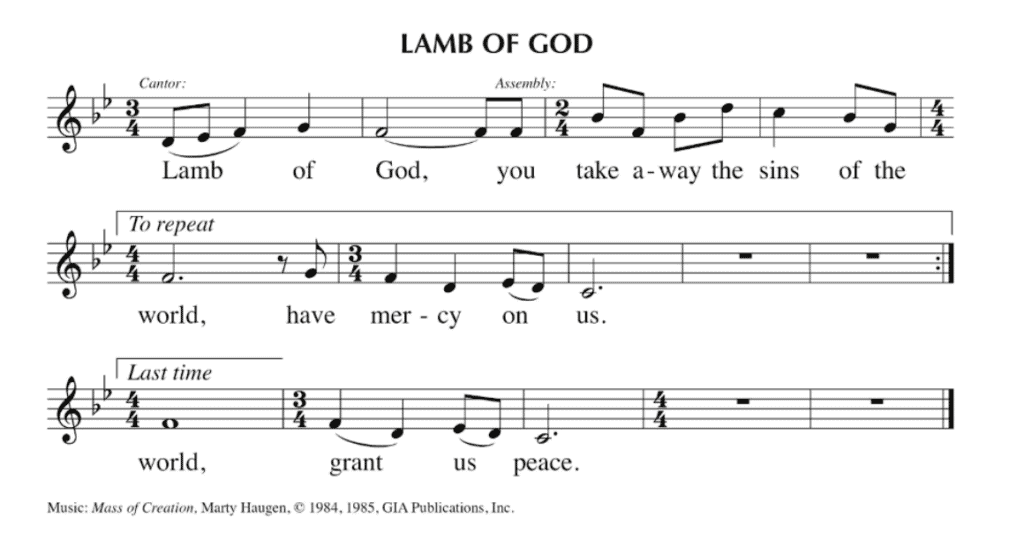
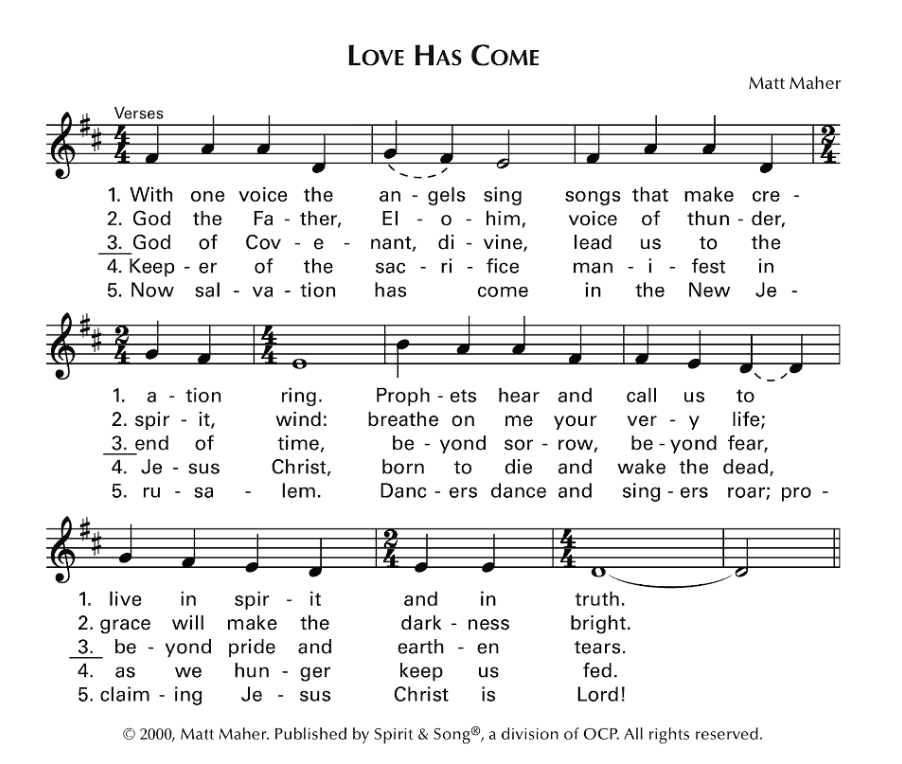
Some pieces of music change the time signature in the middle of the song, sometimes, only for 1 measure. Changing the time signature can help with word stress and the flow of the melody.
Consider Mass of Creation’s “Lamb of God” by Marty Haugen which uses 2/4, 3/4, and 4/4.
“Love Has Come” by Matt Maher also uses multiple time signatures.
Understanding time signatures is important for keeping a steady beat and tempo, as time signatures provide the parameter for each measure. They also provide structure to the rhythms of our texts and melodies through strong and weak beats.
Songs are often in only one time signature, but sometimes composers choose to change the time signature to accommodate the melody and/or text.
Knowing the strong beats of each measure is important when dealing with syncopated rhythms, which is when an accented or strong note appears on a weak beat.
In a future article, we’ll look at more complex time signatures, such as 5/4, 11/8, or 7/16. These time signatures are called asymmetrical meters and are broken down into manageable units.
Written by Emily Banks, who has been a dedicated church musician since the age of 10 and brings a lifelong passion for pastoral music to her ministry. Since 2015, she has served as the Director of Liturgy and Music at All Saints Church in St. Peters, Missouri, where she leads liturgical planning and coordinates a vibrant music ministry.
Copyright © 2026 Catholic Liturgical Ensemble Formation
Looking for more resources? Search our full online library of CLEF Life resources, or sign up for CLEF Life email updates to receive the latest resource in your inbox once a week.