A rest is a moment of silence within a piece of music. We know that our notes have different values (length of time held). Rests (or silent beats) have the same values, and we use the same naming structure. Whole note and whole rest. Quarter note and quarter rest.
Even though musical rests are silent, they deserve just as much care as the musical notes. The rests tell musicians when to punctuate a phrase, when to breathe, or when to create a dramatic effect. They are often used as an important building block for musical rhythms. When playing your instrument or singing, it’s important to note your rests and properly lift your fingers or inhale your breath when the rest appears.
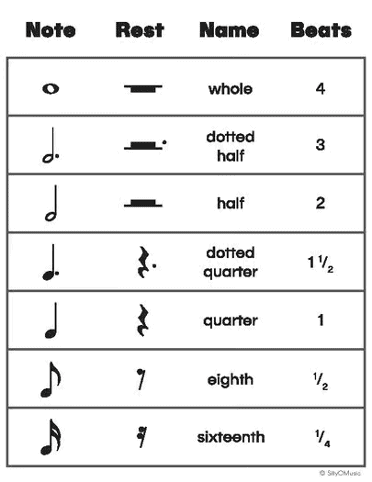
The rhythm of our music carries our melodies, shapes our phrases, and provides structure for our texts. Without rhythms, without placing the notes and silences at a specific moment with the piece, some of the music we know and love would be unrecognizable. Knowing how to play a rhythm requires knowledge of time signatures, measures, beats, note values, and rest values. When all of these come together, music can truly take shape.
Rests and silence within music can accomplish several things. Claude Debussy famously said: “The music is not in the notes, but in the silence between them.” A rest, or a calculated time of silence, allows the music to ring and resonate. It allows the listener to have time to digest the sound. Similarly, a powerful motivational speaker uses properly timed pauses between their sentences for dramatic impact.
In a snappier rhythm, a rest can create anticipation. An unexpected silence can wake up our ears and trick our brains. We expected sound, but surprise, there is silence! Imagine the feeling of thinking there is still one more step at the bottom of a flight of stairs when you’ve already landed at the bottom.
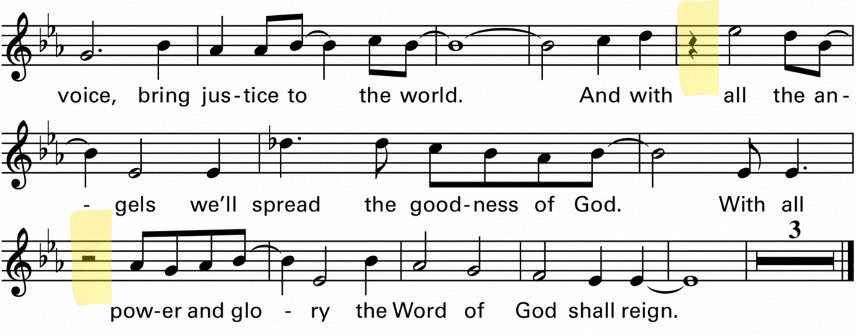
For example, Ricky Manalo’s With One Voice (published by Spirit & Song®, a division of OCP) uses two unexpected places of rest. “And with quarter rest all the angels…” and “With all half rest power and glory…” These rests respectively take up one beat and then two beats of music, yet they are just as important as the sung notes. Within the rhythm of the refrain, it’s an exciting moment of anticipation.
Another example of this would be in the Mass of Saint Ann Gloria (World Library Publications). “Glory! silence! Glory to God in the Highest!” I use an exclamation point to punctuate the “silence” because it’s a loud silence! Here, the rests (an eighth rest and a dotted quarter rest) take up more than half of the measure. That is a significant use of silence, and it creates quite an impact.
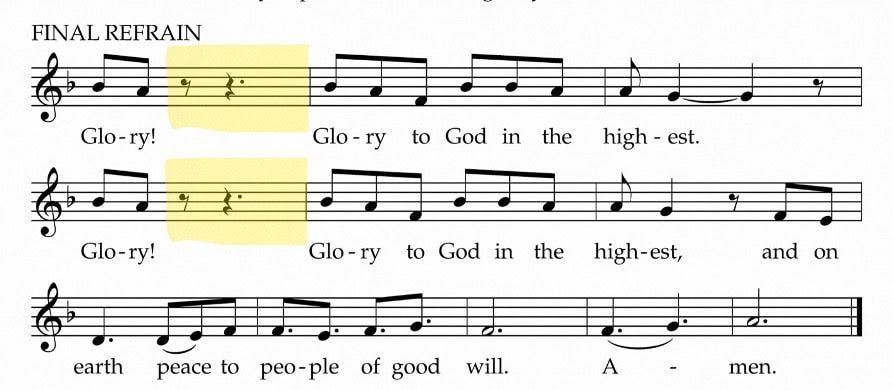
Another use of rests is to notate a breath. In the example above, after the word “highest,” the composer gives the singers an eighth rest, effectively saying, “Breathe here.”
Just as punctuation defines our sentences and paragraphs, rests play a powerful role within the rhythm of our music. They should not be placed below the importance of the notes but counted and acknowledged properly.
Written by Emily Banks, who has been a dedicated church musician since the age of 10 and brings a lifelong passion for pastoral music to her ministry. Since 2015, she has served as the Director of Liturgy and Music at All Saints Church in St. Peters, Missouri, where she leads liturgical planning and coordinates a vibrant music ministry.
Copyright © 2026 Catholic Liturgical Ensemble Formation
Looking for more resources? Search our full online library of CLEF Life resources, or sign up for CLEF Life email updates to receive the latest resource in your inbox once a week.