
The treble and bass clef staffs represent ranges of audible frequencies, meaning they represent certain tones that we can hear. But not every note in our audible range (or the range of many instruments) fits within just the five lines and four spaces of the treble or bass clef staff. In fact, the two staffs are far enough apart in pitch that we require a bridge between them.
Whenever a note is higher or lower than the staff itself, we use what’s called a ledger line to extend our view of the staff. This allows us to keep track of where the pitch is compared to the lines of the staff.
Here we see the treble and bass clef staffs joined together with a single ledger line between them. This view of both the treble and bass clef ranges is referred to as the grand staff.
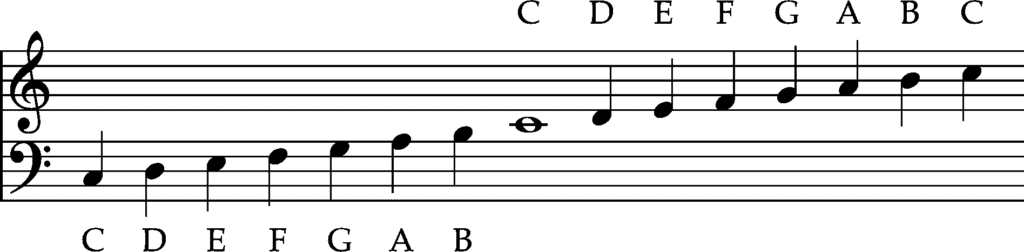
The C in the center is referred to as Middle C. On the piano it is almost in the center of the keyboard, and it is the midpoint between the two staffs.
We can further extend our notation with additional ledger lines.
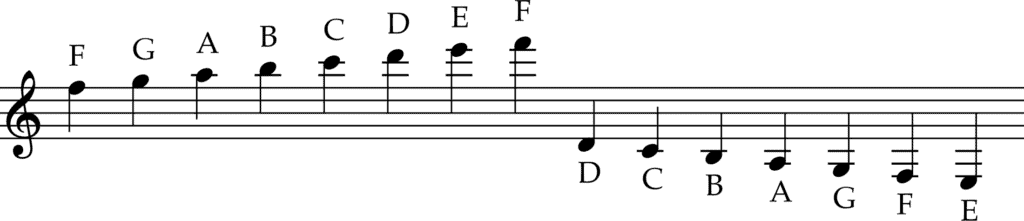
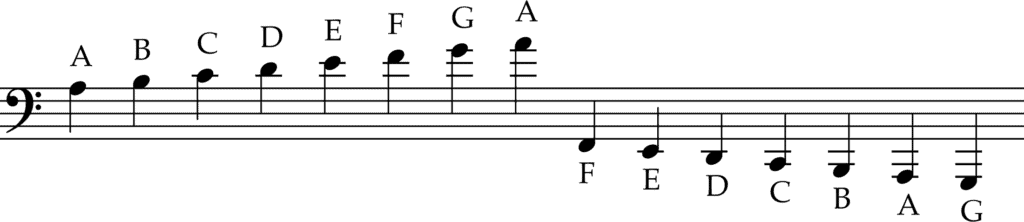
The pattern of letters continues as it alternates between lines and spaces throughout the use of ledger lines in a repeating manner from A to G, then back to A. You can use as many ledger lines as you like or need, but next time we’ll look at a way to simplify notation for notes significantly above or below the staff.
Written by Ray Mullins, a CLEF supporter who has served in music ministry and music education for two decades. He is a music teacher in Tennessee and volunteers as a music minister in various parishes in the Memphis area. Graphics by Christian Cosas.
Copyright © 2026 Catholic Liturgical Ensemble Formation.
Looking for more resources? Search our full online library of CLEF Life resources, or sign up for CLEF Life email updates to receive the latest resource in your inbox once a week.